Research Overview
My name is Justin Frandsen, and I am a Ph.D. student in Cognition and Cognitive Neuroscience at Texas A&M University in Dr. Brian Anderson’s Learning and Attention Lab. My research investigates how visual attention and learning mechanisms guide behavior in complex, naturalistic environments. I use behavioral experiments, eye tracking, and computational methods to examine how people learn regularities, build expectations, and deploy attention efficiently.
Research Focus
Much of my work centers on scene grammar — knowledge of where objects tend to appear within structured environments. Traditionally, research has used real-world objects to study how attention is guided in naturalistic scenes. However, because participants already possess extensive experience with those environments before entering the lab, it remains unclear how this attentional guidance is acquired.
My central research question is:
Can attentional guidance emerge from statistical learning of object–location regularities in naturalistic scenes?
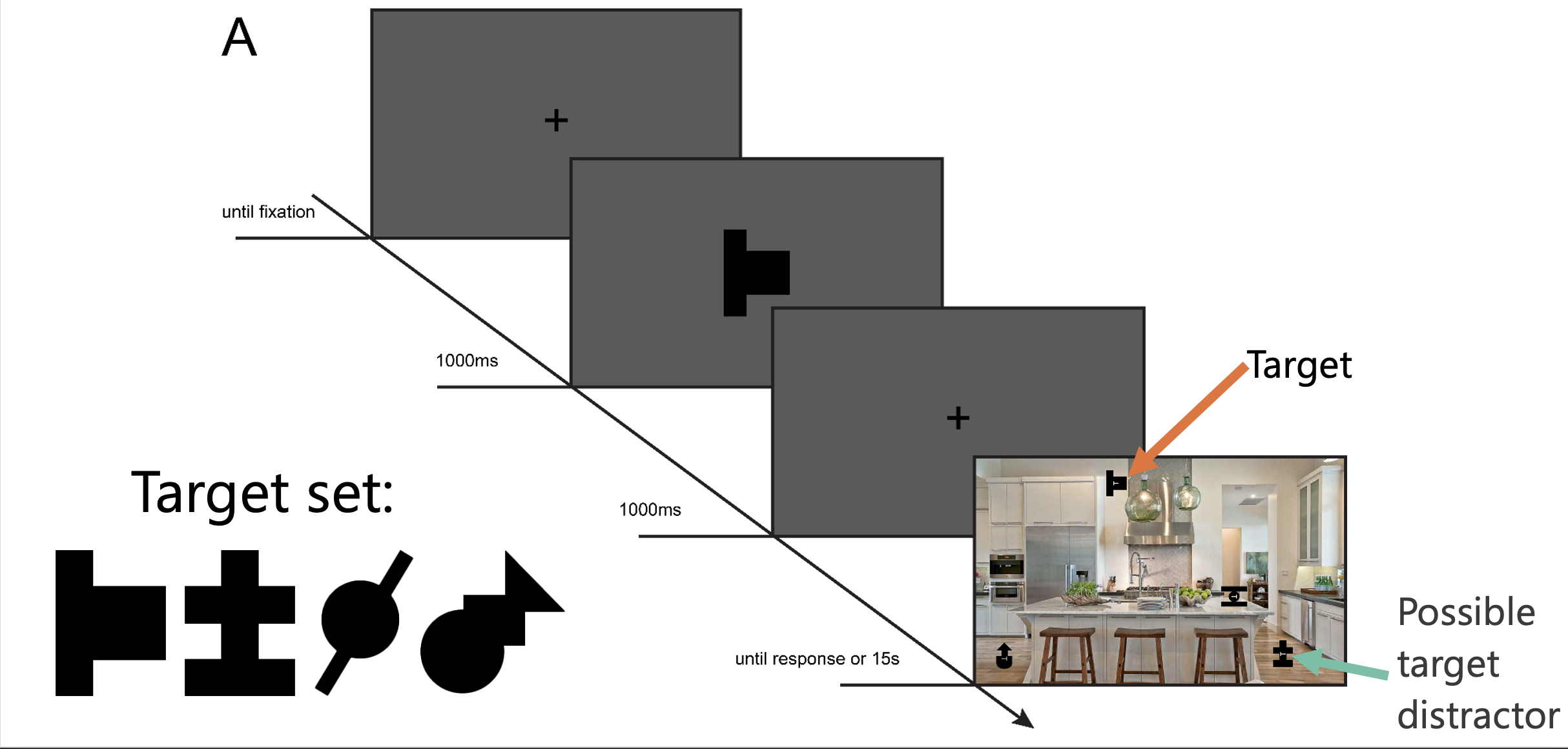
To investigate this question, I developed a visual search task in which participants searched for a target shape embedded within kitchen scenes. Four target shapes were probabilistically associated with different scene regions (e.g., floor, counter, wall), with each shape appearing in its associated region on 75% of trials.
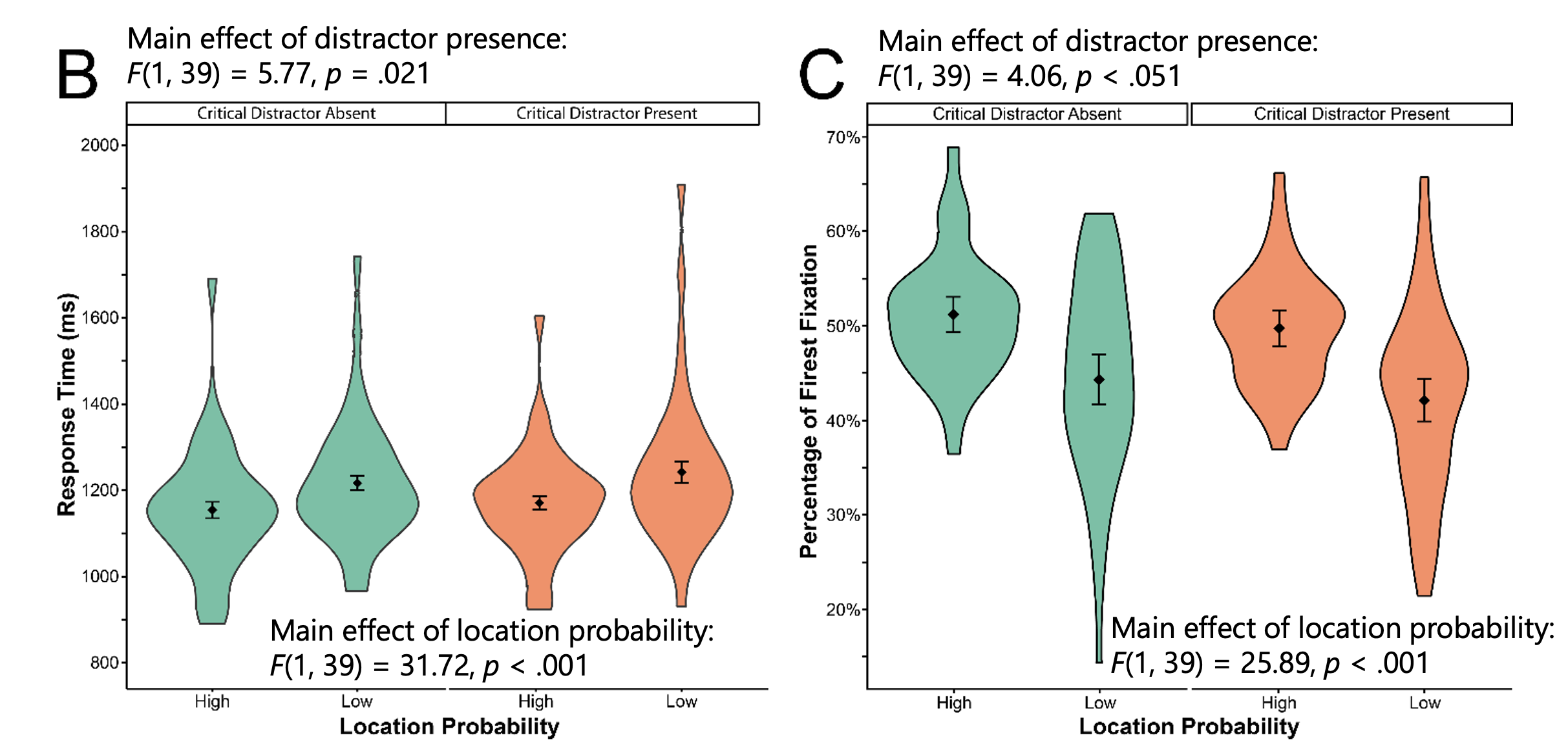
Participants became faster at locating targets when they appeared in their high-probability regions compared to low-probability regions, demonstrating that attentional guidance can emerge through statistical learning alone.
This work has been accepted (and other experiments) for publication in the Journal of Experimental Psychology: Learning, Memory, and Cognition.
Frandsen, J. L. & Anderson, B. A. (accepted). The role of statistical learning in attentional guidance during search through naturalistic scenes. Journal of Experimental Psychology: Learning, Memory, and Cognition.
Current Projects
Exploration and Context-Dependent Distractor Suppression
Investigating how visual exploration after search facilitates statistical learning of distractor–location regularities in naturalistic scenes, and how learned associations transfer to subsequent target-guided search.
Independent Suppression of Multiple Salient Distractors
Examining whether the visual system can independently suppress dynamic and static salient distractors across different display contexts.
In collaboration with Brad Stilwell.
Attentional Bias to Rewarded Object–Location Associations
Testing whether reward history produces object–location associations similar to those acquired through statistical learning, using eye tracking to quantify reward-modulated attentional guidance.
In collaboration with Sojung Youn.
Context-Dependent Learning in Drinking-Related Scenes
Examining how prior experience with alcohol-related contexts influences object–location learning and attentional guidance in naturalistic scenes.
In collaboration with Sojung Youn.
Saliency and Threat Detection in Fire Imagery
Applying computational saliency modeling (GBVS) and image segmentation to investigate whether fire automatically captures attention in captive primates with no prior real-world fire exposure.
In collaboration with the Yorzinski Lab.
Publications
Peer-Reviewed Publications
Frandsen, J. L. & Anderson, B. A. (accepted). The role of statistical learning in attentional guidance during search through naturalistic scenes. Journal of Experimental Psychology: Learning, Memory, and Cognition.
Manuscripts in Preparation
Frandsen, J. L., Stilwell, B. T., & Anderson, B. A.
Independent suppression of multiple salient distractors.
Frandsen, J. L. & Anderson, B. A.
Curiosity ignored the cat: How exploration promotes context-dependent distractor suppression in visual search through real-world scenes.
Lake, B. R., Whitham, W., Schapiro, S. J., Frandsen, J. L., & Yorzinski, J. L.
Chimpanzees (Pan troglodytes) and olive baboons (Papio anubis) preferentially view fire in naturalistic images.
Conference Presentations
Vision Sciences Society — 2025
Frandsen, J. L. & Anderson, B. A.
The role of scene context in the guidance of attention based on object–location associations.
Psychonomic Society — 2025
Frandsen, J. L. & Anderson, B. A.
Up to the challenge: Suppression of multiple salient distractors.
Vision Sciences Society — 2024
Frandsen, J. L. & Anderson, B. A.
The role of statistical learning in attentional guidance during search through naturalistic scenes.
Skills
Programming & Analysis: Python, R, MATLAB, tidyverse, pandas, NumPy, SPSS, JASP
Experiment Design: PsychoPy, Psychtoolbox
Eye Tracking & Neuroimaging: EyeLink 1000, DataViewer, EEG collection & preprocessing
Computational Methods: GBVS saliency modeling, image segmentation (OpenCV, scikit-image)
Other: GitHub, Microsoft Office
More publications, datasets, and project materials coming soon.